Skip to content

And then there were none…

…warm floors in our house, that is.  Recently, I wrote about our lack of upstairs heat.  Well, just in time for the first mid-20 degree nights of the season, the circulator pump for the downstairs heat decided to go belly-up on us.  The good news is that I was home to hear it and shut the boiler down before any major damage was done.  The bad news is that the warranty company is really outdoing themselves with this claim.  First, they called accusing us of trying to have them come fix the upstairs heat, which they’d already refused to fix earlier.  Now, they claim that nobody in our service area can work on a boiler.  Never mind that they sent somebody out to work on our boiler a few weeks ago.  The company has made it our responsibility to find a contractor and have them “pre-authorized” by their agents.  Then, they’ll consider reimbursing us for the fix, assuming it isn’t excluded in their shifty, fine print contract, the same one with the smiling HVAC technician replacing a family’s broken-down A/C system on the cover.  Anybody want to make a bet on how this will go?

American Home Shield’s business is a sham.  They prey on nervous new homeowners who hope to protect their wallets from further damage.  They make any and every effort to deny claims, knowing full well that their business model doesn’t add up if they don’t.   Their practices are deceitful, unfair and just plain wrong.  I’d gladly take my money back in place of this headache.

Fortunately, I had the perfect stay-warm activity lined up for the holiday weekend: raking the yard.  It took three partial days to finish and clearly hadn’t been done for many years.  My shoulders and neck are reluctant to forgive me, but the lawn looks good.

Without any yard work to be done during these early dark evenings, it gets a bit chilly.  We bought space heaters, but they’re outmatched by our tall ceilings and drafty windows.  I’m sure that someday we’ll regale our kids with stories of survival from our first winter in the house.  But for the moment, our funny bones are frozen.

Mostly.

Gobbles!

Happy Turkey Day, ya’ll!  The missus is working, and so are the painters, so I count myself lucky to be able to enjoy my coffee at a leisurely pace before heading to the yard for some good old-fashioned raking.  Weezie and I were in New York City last weekend for a friend’s wedding.  It was a great time to visit, crisp but not bone-chilling, with holiday decorations just beginning to appear.

One thing that kept catching my eye were the “for rent” signs all over the city which used “pre-war” vintage as a selling point.  In big-city parlance, I know this translates to: “pint-sized, but with craftsmanship and details not found in newer construction”.  If I lived in the City, I would no doubt be among those people attracted to earlier apartment buildings.  It reminds me, though, of my favorite old-house quote:

“It’s not good because it’s old, it’s old because it’s good.”

Most of New York’s colonial past is literally buried, with new buildings continually replacing older ones.  This forward-looking attitude is exactly what one expects in the Big Apple, but it makes me appreciate even more how lucky we are to own a home that’s pre-Revolutionary war, with craftsmanship to match.  Any Europeans reading this are snickering at the delight I derive from this 260 year old structure, but I really get a kick out of having a physical connection to that formative period our country’s history.

Today, I count myself very lucky and very thankful for our new home, and for all the interesting stories it will tell us over the years.

Happy Thanksgiving!

Bring the heat

Weezie, Meg and I powered through the first fall cold snaps with the help of thick sweaters and blankets. Finally, two weeks ago, we made the decision to fire up the boiler, a hulking steel box that lives at one end of the basement.

It’s an old oil-burning unit that has been converted to natural gas, feeding baseboard radiators through a spaghetti-like network of copper pipes.  There’s something oddly appealing about its old-fashioned hulk.  It reminds me of cars of a similar vintage, from a time when efficiency was overlooked in favor of muscle and bold styling.  The “Winkler” logo on the front even looks like a badge ripped off some old Detroit steel.

I was unprepared for the symphony of bangs, knocks and whooshes that would accompany start-up.  I flipped the breaker on, opened the gas valve, heard the click of ignition and then a deep, rumbling roar as the flames began doing their work.   The circulator pump squealed to life and pushed water into the pipes, which creaked from expansion.  The boiler is located directly below the living room.  Because the floor boards in that part of the house sit directly on the joists, the boiler might as well be in the room with us.  It’s loud.

Retiring this system is high on our list of priorities.  It needs to go for a number of reasons:

  • The exhaust gases are eroding the mortar on the interior of the chimney flue.
  • The baseboard heaters conceal the base molding all over the house and prevent us from opening any walls.
  • Despite our house’s nickname “Seven Hearths”, there’s actually an eighth fireplace closed in behind the boiler.
  • It’s inefficient.  New boilers are up to 96% efficient (meaning 96% of the fuel burned turns into heat).  This unit’s efficiency is probably somewhere in the 70s or lower.

Despite the boiler’s audible protests, it performs reasonably well.  It’s not the kind of heating system you crank up to 75 degrees for the winter.  But set in the mid-60’s, it chugs along and provides non-drafty, comfortable heat.

Unfortunately, that heat doesn’t make it everywhere.  Turns out that there’s a short in the thermostat wire for upstairs, and the circulator pump for that loop won’t cycle on.  I actually enjoy sleeping in the cold, but getting out of bed sans heat on a 30-degree morning can be challenging, to say the least.  We got a home warranty thrown in with the house at purchase.  After the company (starts with ‘A’, ends with ‘merican Home Shield’) initially agreed to cover the fix, they reneged and claimed that we were responsible for tearing out walls and identifying the break in the wire before they would pay up.  The logic of this makes me really angry, so I try not to think about it.  The HVAC guy offered to install a wireless thermostat for a cool grand; we passed.  I’m going to rig up a temporary t-stat in the basement to get us through winter.  But for a little while longer, we’ll be doing our mornings authentic colonial style: cold.

Better housing through chemistry

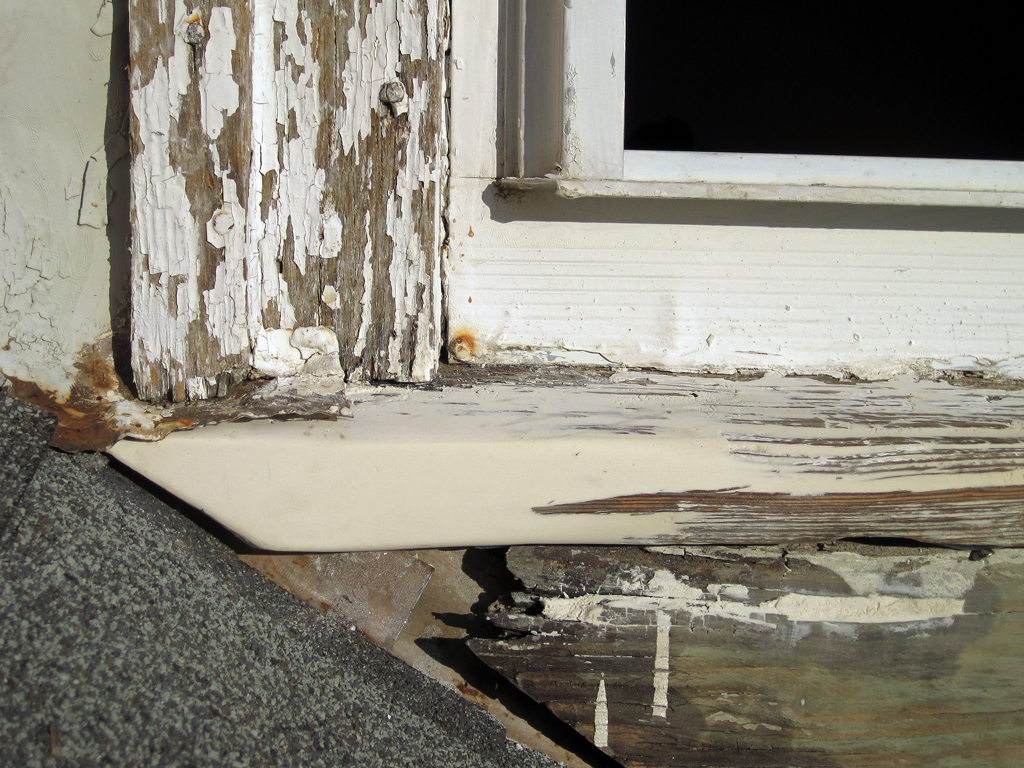
While crawling around the house with the painter looking for wood that needs replacing, I spotted one windowsill that was particularly ragged.

Sitting inches from the roof for a few hundred years will do that to a piece of wood. Still, it’s remarkable how solid the remaining material was; old growth wood is amazing stuff.  We could have paid a carpenter untold sums of cash to replace the sill with lesser-quality wood, but I saw a great opportunity to try an epoxy patching system sold by Abatron, a company that’s endorsed  by historic preservation organizations around the country.  The system consists of two steps: the first is to soak the wood with a consolidant that solidifies the dry rotted and damaged material.  This creates a solid base for the second step, that starts with the mixing of a two-part epoxy putty with the consistency of Play-doh.  You stuff the mixture into the void you’re filling, shape it to roughly the final shape of the profile you’re matching, and sit back to let the chemical reaction of the resin and hardener do its magic.  A few hours later, the patch is rock solid.  I sanded this patch with a random orbit sander, gradually carving it to the shape of the original sill.

The cured material is waterproof, flexes with the wood and will never rot.  Reports of its long-term adhesion are good, so I’m optimistic that this is a fix that will help this sill live on for many more decades.  The epoxy system is not cheap.  This patch probably consumed $15-20 worth of material.  But when put up against the carpentry costs of replacing the sill, and knowing that the original material lives on, it’s an absolute bargain.

All fenced in

The ordinary is fenced, ya’ll.  The fence contractor made quick work of the installation, and now the yard is suitable for wayward hounds.

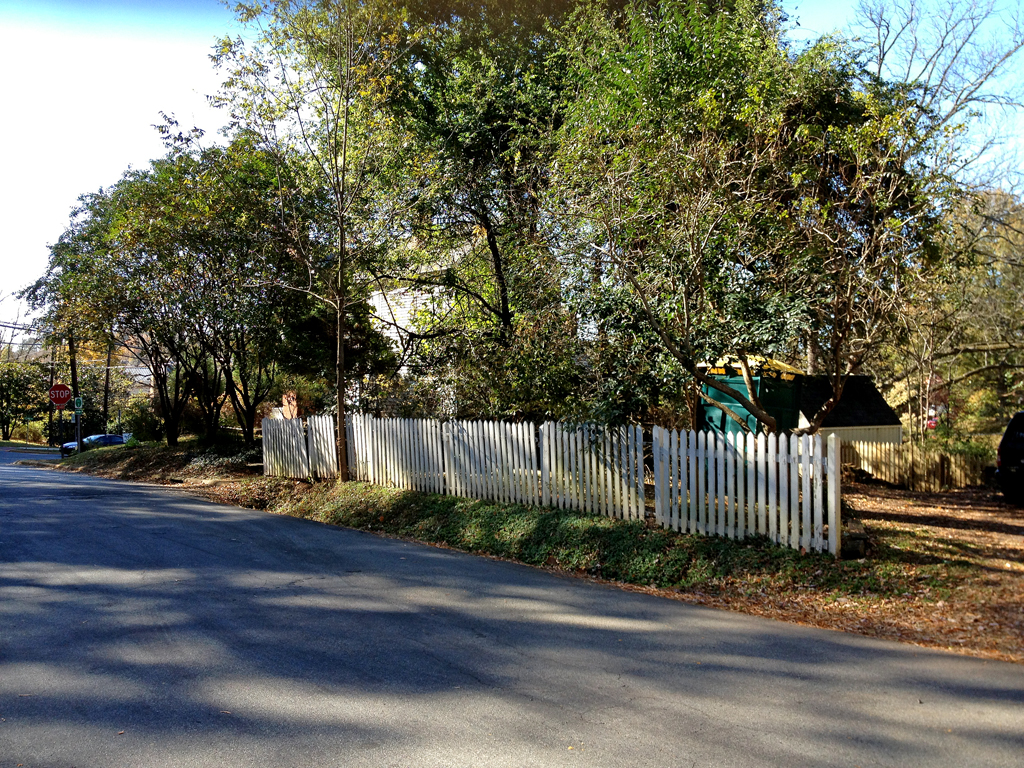
The picket fence out front was built to resemble what was there before, minus the falling apart part.  The wood is pressure-treated pine, so we’ll let it dry out over the winter before painting it white in the spring.

The house has looked better.  With plastic in the windows, a whole lot less paint on the siding, and faded-paint shutters, it takes some vision to realize that progress is being made.

Out back, we built a new section of picket fence similar to the one in front.

For now this means that we have to go through a gate to get to the back door.  Long term, we think we might relocate the door to where the small window is on the left side of the picture.  We know from photos that the door lived in that spot in a former life:

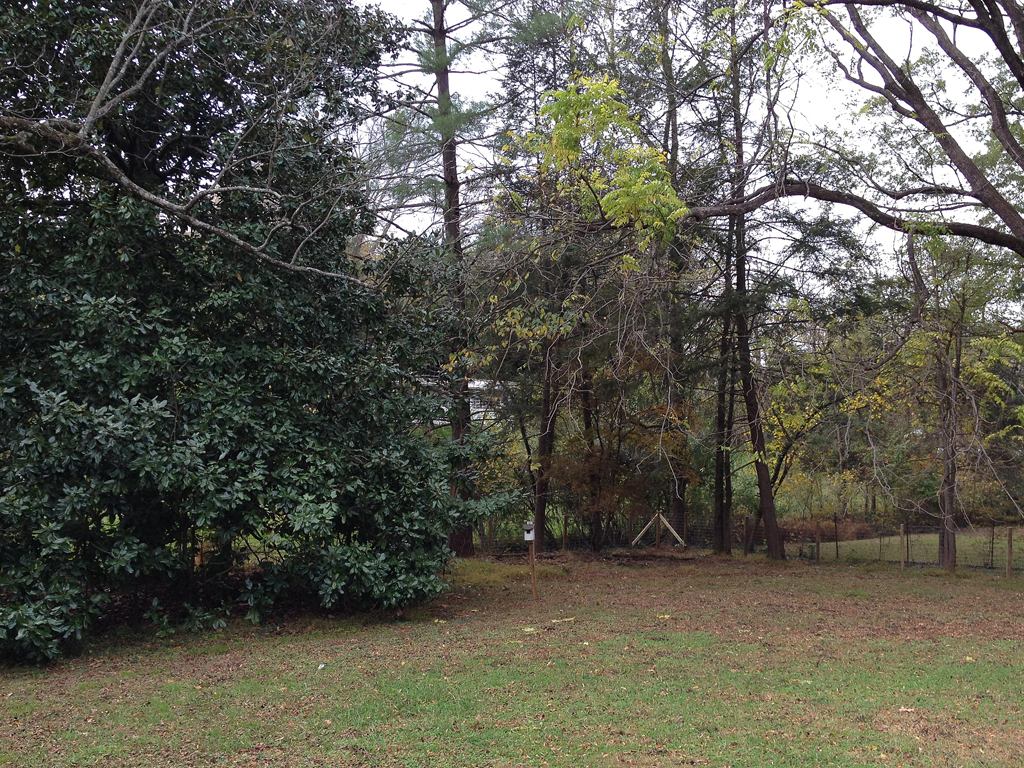
In the rear and side yards, the fence transitions to a post and wire type.  Can’t see it?  Exactly.

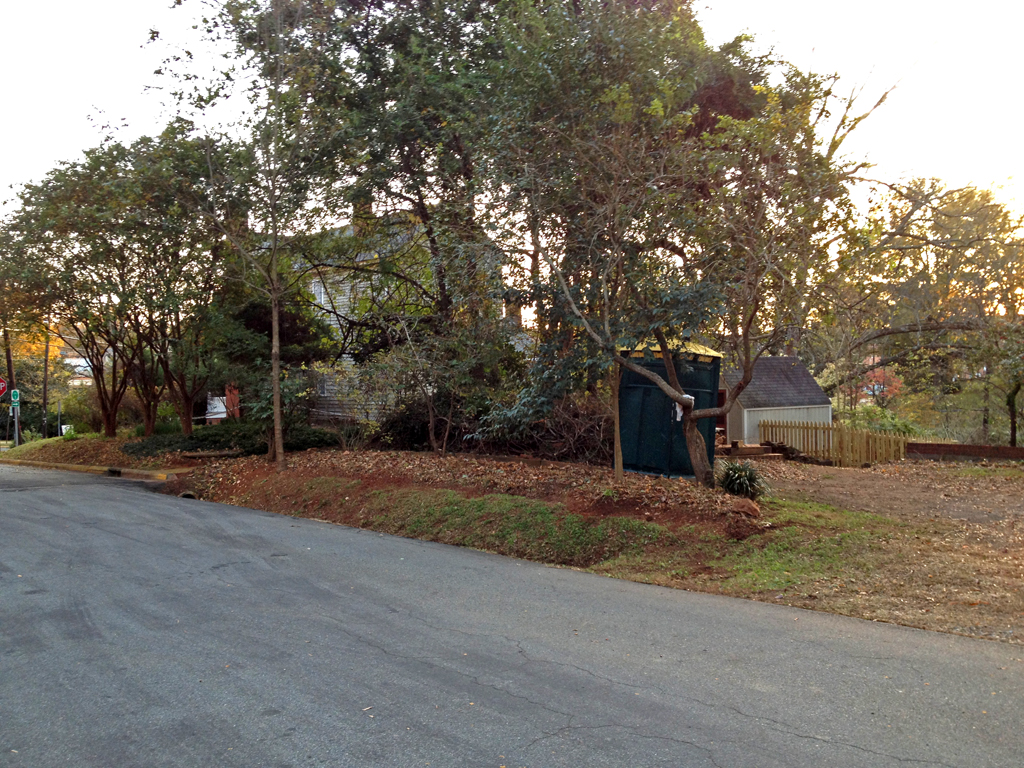
After getting the fence around the yard ship-shape, the segment along our parking area started to look really bad by comparison.

It leaned like a drunken sailor and was missing several pickets, so I took it out this weekend.  The posts were almost completely rotted through, so knocking the sections over took little more than a forceful shove.  While I was at it, I cleaned out the culvert pipe that passes beneath the driveway and raked the leaves from the drainage swale.

I wasn’t certain that this would be a good change, but it makes the yard much brighter and more friendly.  We’ll probably add some plants this spring to restore some of the screening the fence provided.  Yes, that’s a Porta-John.  No worries, our indoor plumbing still works.  But with painters on site for at least a month, it’s a necessary yard ornament.

187 at 157?

We reeled in a grand total of (wait for it) THREE trick-or-treaters last night…and they came in one trip.  Not exactly the haunted hootenanny we were prepared for.  Turns out that $50 buys a lot of candy and Weezie and I both hauled a fat sack of it to work this morning.

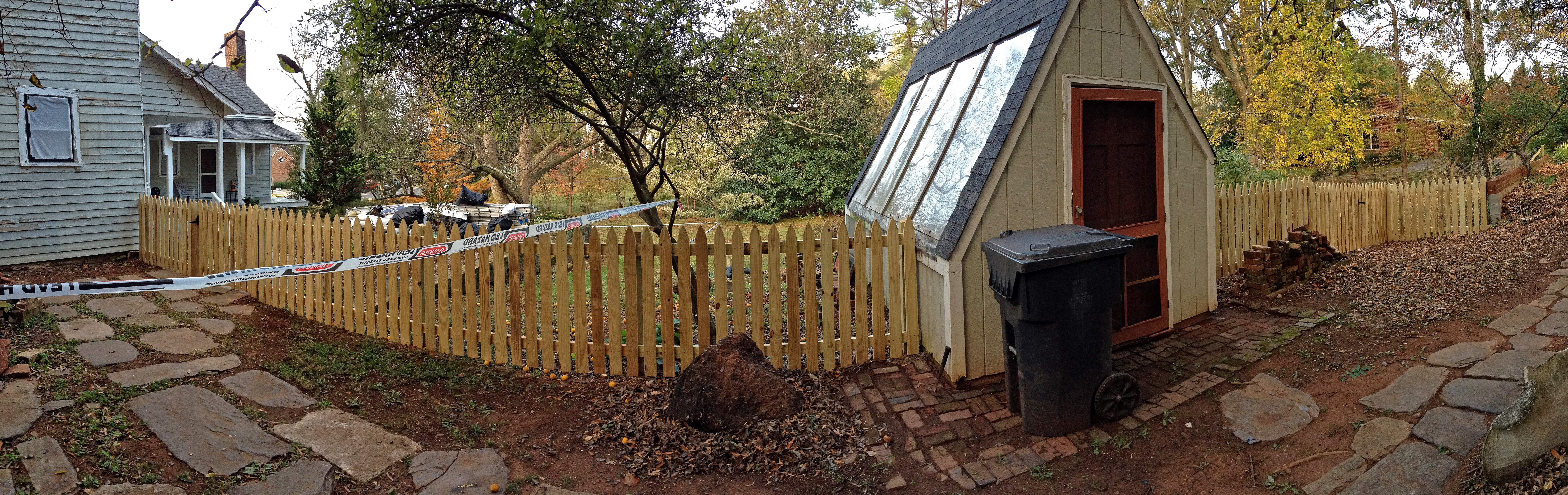
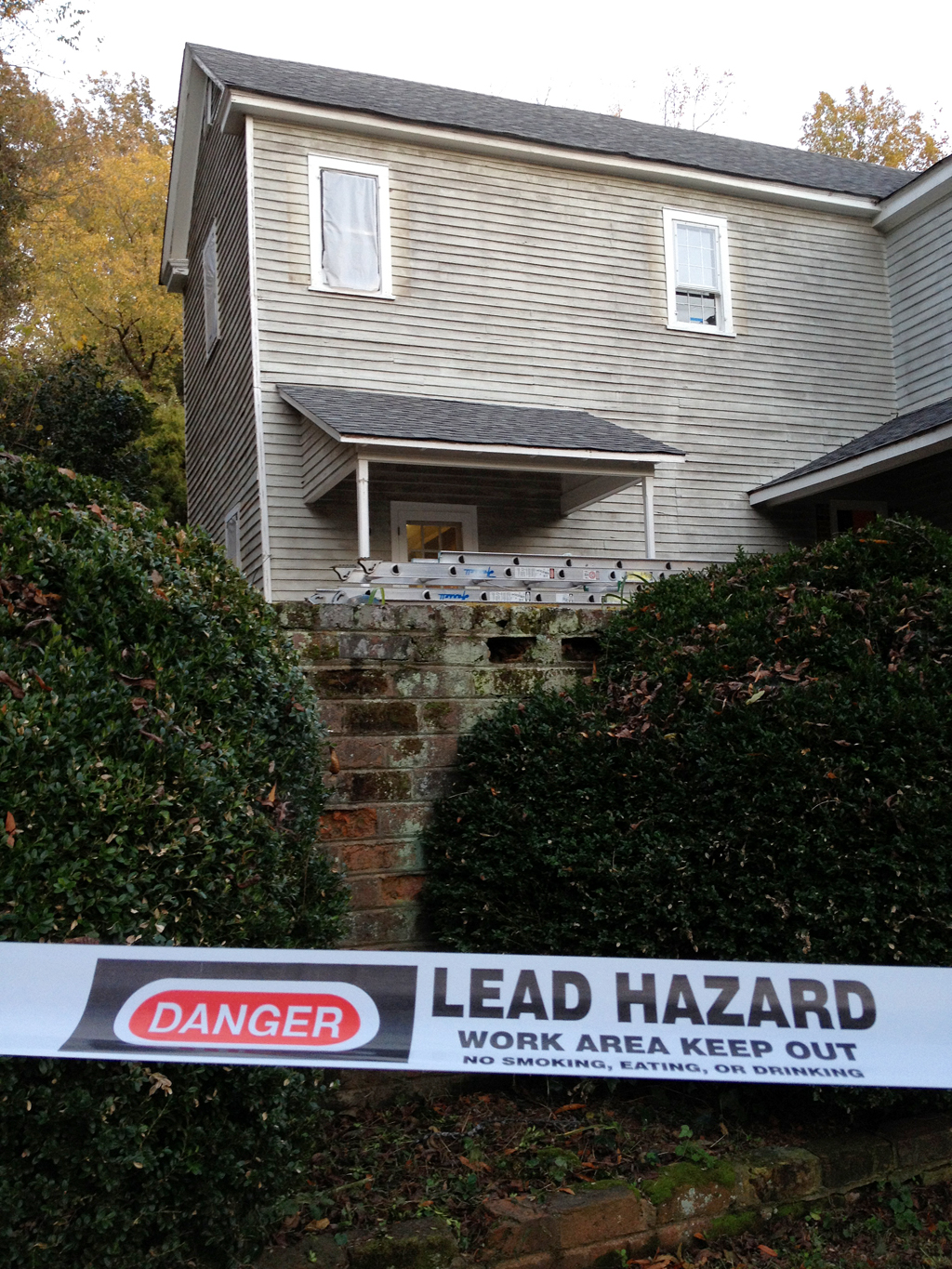
Maybe we can blame the underwhelming treater turnout on the tape strung all around our yard which, at a glance, makes it look like a crime scene:

Our painters started yesterday and the tape is part of their compliance with the lead paint renovation laws enforced by the gub’mint.  If they don’t comply, they leave themselves vulnerable to hefty fines if an EPA agent were to visit the job site.

The sequence of events for the job will be: scrape, sand, wash, scrape again, apply primer x 2, apply top coat x 2.  Right now, the painters are on their first round of scraping, which is done after wetting the wood.  The company we’ve hired owns a fleet of electric sanders attached to HEPA vacuums.  This allows them to safely sand the siding without releasing clouds of lead dust.  It also means that the painters can really lean into their scrapers; any errant gouges or fraying of the wood will be worked out once they get to sanding.  There’s some beautiful, dense, old-growth wood underneath that peeling paint.

I’ve spent a fair chunk of my life with a paint brush in hand: I earned money by painting houses during the summer in high school and more recently painted our house in Chapel Hill, inside and out.  I can convince myself that it’s fun for short periods of time, but the epic amounts of prep involved with this job leave me very happy to leave it in someone else’s capable hands.

Happy Halloween

Not sure what to expect from a Hillsborough Halloween, but we’re loaded down with $50 worth of candy, a carved pumpkin and  costumes…for Meg.

Before tour: the kitchen

If there was an interior decorating style called “50’s country”, our kitchen would be a leading exemplar of the type.  Brick pattern linoleum floors, wormy-wood cabinets with wrought-iron strap hinges, and ye olde appliances leave us yearning for the kitchen we left behind.

The large beams at the ceiling seem to indicate that this room was once a separate structure, with a roof of its own.  This was typical in the American South, and was done to keep extra heat out of the house.  With “help” to do the cooking, the inconvenience of a detached kitchen was easy to overlook.

Despite its fascinating past, the kitchen’s present condition leaves a bit to be desired.  It’s also down a set of steps, so it’s not entirely convenient for 2 a.m. kitchen raids.  To remedy this situation (hardcore preservationists, cover your ears), we intend to build a new kitchen in the current dining room, on the main level of the house.  Since the kitchen is the room closest to the driveway and serves as the main daily entry and exit point for us, we think it has a fine future as a mudroom.

Got a light?

Our painter won’t start until next week due to weather delays and anticipates being on site for 4-6 weeks (so THAT’S where all that money’s going…).  So even though we won’t have a new paint job until early December, it’s hard not to look forward to a few post-paint projects that will help the exterior of the house shine.

One of those projects is the installation of a new light at the front porch.  The existing fixture is a builder’s special that isn’t special at all.  It’s undersized, throws a harsh light and is generally unremarkable:

To my mind, the size and configuration of the porch demands a hanging lantern that will cast an inviting glow on this quintessentially southern space.  Something traditional, timeless and tasteful.  Here are six options that I’ve dredged up from around he interwebs.  All are relatively affordable, built of durable materials, appropriately sized, and good-lookin’.

We’ve decided on our favorite, but I’m interested to know what everyone else thinks.

Going on the offencive [sic]

One of our first major projects for the new house was to install a fence for the dogs (priorities, right?).  Our planning efforts started well before we moved since we needed formal approval of the style and placement of the fence from the town’s Historic District Commission in order to build.  Similar groups in nearby towns have reputations as project-killers (ahem, Chapel Hill, ahem), so I was a bit nervous leading into the approvals meeting. Fortunately, my concerns were unfounded.

We considered several types of fence, but ultimately decided to replicate the existing white picket fence on the street-facing sides of the property and to use a post and wire style along the inside lot lines.  We weren’t certain that the wire fence would be acceptable to the commission, but they were reasonable and agreed that it was the least visually-intrusive fence style for side and rear yards.

Our fence builder started on Friday and will probably wrap up in the next day or so.  I’ll post more images when it’s complete, but I wanted to share one view that I particularly like:

There’s something primally satisfying about defining a dead straight line in a decidedly non-linear world. Perhaps it’s the control freak in me, or maybe the architect (or both), but I really enjoy the occasional rational overlay on our wild and woolly wilderness.